
Tesamorelin 10MG
$ 125
Tesamorelin 10mg
Tesamorelin is a synthetic 44-amino acid analog of growth hormone-releasing hormone (GHRH), distinguished by a trans-3-hexenoic acid modification at the N-terminus that enhances stability and resistance to enzymatic degradation compared to native GHRH sequences. Originally developed as TH9507, this structurally modified peptide has been the focus of substantial biochemical and cellular research literature.
Tesamorelin Structure
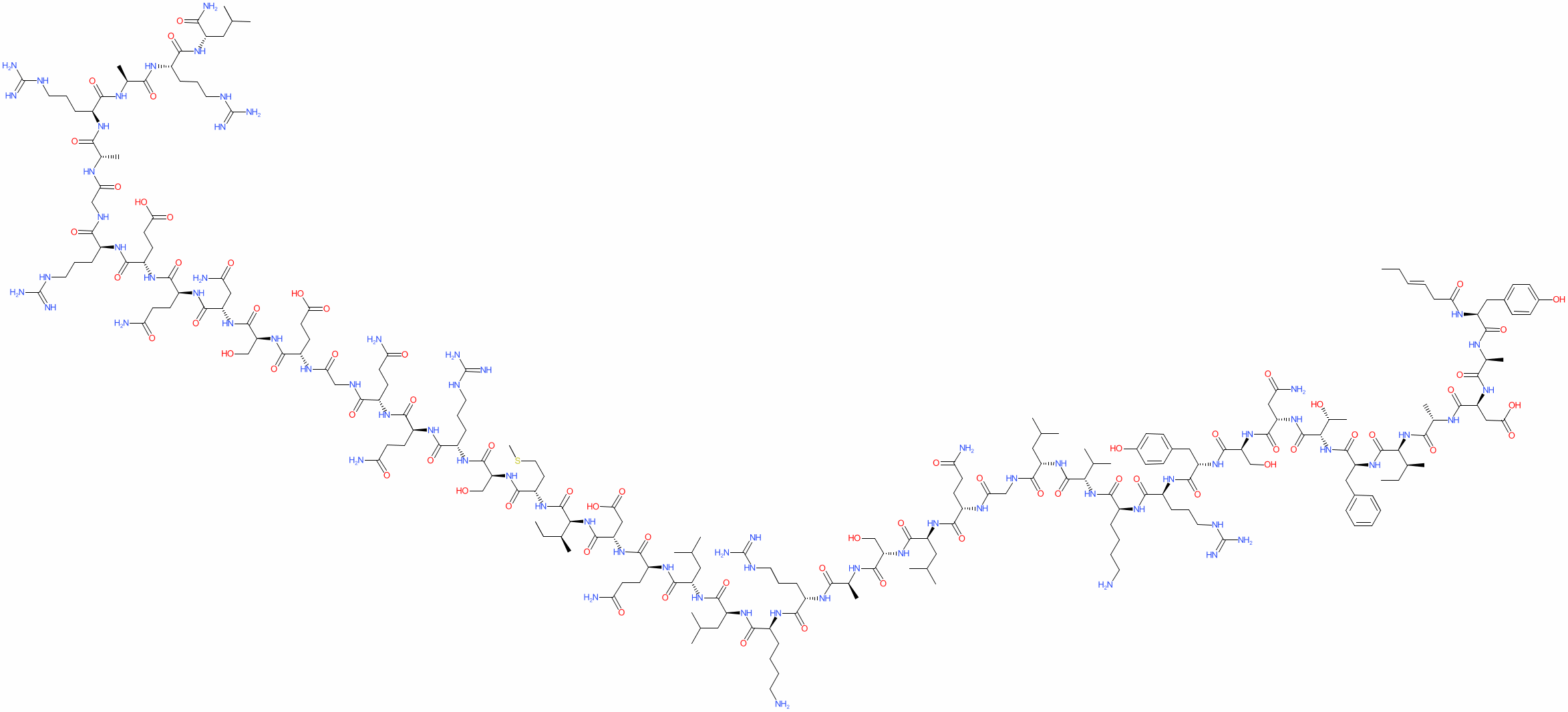 Sequence (Single Letter): Unk-Tyr-Ala-Asp-Ala-Ile-Phe-Thr-Asn-Ser-Tyr-Arg-Lys-Val-Leu-Gly-Gln-Leu-Ser-Ala-Arg-Lys-Leu-Leu-Gln-Asp-Ile-Met-Ser-Arg-Gln-Gln-Gly-Glu-Ser-Asn-Gln-Glu-Arg-Gly-Ala-Arg-Ala-Arg-Leu
Molecular Formula: C223H370N72O69S
Molecular Weight: 5195.908 g/mol
PubChem CID: 44147413
CAS Number: 901758-09-6
Research Background
Tesamorelin has been investigated in research literature across several scientific contexts:
- GHRH receptor pharmacology — investigations into receptor binding kinetics, signal transduction, and downstream cellular pathways
- Pituitary cellular biology — studies examining anterior pituitary cell responsiveness to modified GHRH analogs
- Peptide stability engineering — comparative research on N-terminal modifications and their effect on peptide half-life, degradation resistance, and biological activity
- Structure-activity relationships — analytical chemistry research examining how the trans-3-hexenoic acid modification alters peptide behavior vs. native GHRH
The compound’s structural design — particularly the N-terminal modification — represents a notable case study in peptide engineering aimed at improving stability properties of naturally occurring signaling peptides. Foundational research on the GHRH receptor system and its synthetic analogs is extensively documented in peer-reviewed scientific literature for researchers seeking deeper biochemical context.
Storage
Storage Instructions:
Store the lyophilized reference standard at minus 20 degrees Celsius, protected from light and moisture. Once placed in solution with a laboratory solvent, hold the solution at 2 to 8 degrees Celsius and use it within 30 days. Solvent selection and handling are the responsibility of the receiving laboratory.
Related products